Chemistry is full of stories about substances that show up, grab attention, then quietly shape how we live—not with fanfare, but with steady usefulness. Trimethyl borate fits that description. Introduced early in the 20th century, it captured interest when chemists needed easier ways to handle boron. With boron’s role spanning from metallurgy to medicine, any compound that allowed boron to travel, react, or slip into more complex molecules opened doors. Early days saw it distilled in basic lab setups, made by bubbling methanol through boric acid and gathering the result over dry conditions. The simplicity drew researchers in, since complex apparatus or rare reagents weren’t required. Once scale-up entered the picture, the discovery matched with the growth of industrial uses for boron, and trimethyl borate carved out a spot as both a research tool and a chemical building block. I remember cracking open old lab notebooks and seeing its name pop up alongside organoboron pioneers, a little reminder that even “simple” molecules can change industries.
The chemical formula B(OCH3)3 reveals a trifecta of methoxy groups hanging off boron. The result: a clear, colorless liquid with a faintly sweet odor, almost like some alcohols. Boiling at just below 70°C, it behaves like a typical organic solvent—you pour it, you weigh it out, you store it away from air and water. Its low viscosity and high volatility bring fire risks, but they also grant flexibility. Researchers gravitate toward chemicals that deliver both boron and a reactive handle, especially in organic synthesis. Synonyms like “boric acid trimethyl ester” and “trimethoxy borane” come up in paperwork, but most chemists just say trimethyl borate. The liquid’s low flash point challenges storage and shipping, making safety a constant conversation any time large quantities move around.
This liquid’s low water solubility always requires careful handling, since even a drop of moisture triggers a hydrolysis process that kicks out methanol and leaves boric acid behind. In my own experience, opening a bottle in a humid lab would guarantee cloudiness in moments. Its density sits just under water’s, and the vapor can travel—sometimes catching a stray spark, leading to dramatic fireballs. That volatility grants utility in making boron-containing vapors for flame tests or chemical vapor deposition. Chemical reactivity stands out; it can donate its methoxy groups to a variety of syntheses, moving boron into new places inside complex molecules. That pattern explains why so many research papers trace new organoboron compounds back to this unassuming liquid.
Most preparation runs off a single strategy: mix excess methanol with boric acid or boron trioxide, let react under gentle heating with water removal. When water stays, it reverses progress, so drying agents or azeotropic distillation come into play. In well-equipped labs, the process can run continuously for large-scale needs, but even in resource-constrained environments, smaller yields remain practical. The impact of such a straightforward process means that access to trimethyl borate doesn’t depend on any one geography or manufacturer, helping open opportunities for more diverse research groups globally.
If you want to convert boron’s reactivity into useful chemistry, trimethyl borate stands ready. It slips into Grignard reactions, steps in to make boronic acids or esters, and feeds into Suzuki-Miyaura cross-coupling—one of organic chemistry’s backbone transformations. Once it delivers its boron to a carbon center, its methoxy groups ride away as methanol, leaving a functionalized molecule behind. It can also hydrolyze under acidic or basic conditions, turning quickly into boric acid. People have studied its modifications: swap out methoxy groups for bulkier ones, or use isotopically labeled methanol to follow reaction paths. Those options expand utility for both basic and applied research.
Nobody buys or uses chemicals in a vacuum. Real-world labeling focuses on purity—typically 99% or higher for research-grade material—along with warnings for volatility, flammability, and toxicity. Anyone picking up a bottle knows to work in a fume hood, wear goggles, and keep sources of ignition far away. There’s always an MSDS on hand, which, judged by experience, must be more than a formality in well-managed labs. Storage bottles stay tightly closed, usually under nitrogen or argon, to keep air and moisture out. Drums and shipping containers take on extra fireproofing, with color codes and clear hazard markings as required by regulations from OSHA and DOT in the US and their counterparts abroad.
The biggest risk comes from methanol as a hydrolysis by-product. Methanol is notorious for damaging the optic nerve and causing permanent blindness if ingested. Trimethyl borate also generates flammable vapors, creating explosion hazards in busy labs or plants unless handled with proper ventilation. Inhalation exposure, even at low levels, brings headaches, dizziness, or worse if concentrations climb. Most labs install fire suppression systems wherever large volumes are stored, maintain clear evacuation routes, and make sure even new trainees grasp the gravity of these risks. Regulatory agencies set exposure limits, and real-life compliance boils down to more than checking boxes on a form—it’s a mindset that anchors daily routines.
Synthesis of complex organoboron molecules matters not just for making academic curiosities, but for industries seeking new materials and medicines. Suzuki-Miyaura reactions, powered in part by trimethyl borate, underpin the synthesis of key pharmaceuticals—anticancer agents and anti-inflammatories trace roots to these chemistries. In the field of semiconductor manufacturing, trimethyl borate provides a vapor-phase boron source for doping silicon wafers, fine-tuning electronic properties. As a flame colorant, it produces a bright green in pyrotechnics, bringing entertainment and instructional value. Its role spans mainstream applications as well as niche technical needs. The tool-belt metaphor comes up a lot: you add it once, tweak some properties, and move on to the big prize, whether that’s a better OLED screen or a faster, more stable drug molecule.
A surge in organoboron chemistry over the past few decades owes much to easy borate esters like trimethyl borate. Researchers keep finding new reaction types—photocatalytic couplings, borylation of sp3 carbons, greener synthetic routes—that hinge on boron reagents. Boron’s versatility—helping electronics, solar cells, polymer science, and medicinal chemistry—starts with access to building blocks that scientists can scale. European and American labs, sometimes racing, sometimes collaborating, keep returning to trimethyl borate as a go-to in exploratory syntheses. Emerging interests in isotopically labeled boron compounds for neutron capture therapy or advanced materials feed further demand. I’ve seen projects pivot successfully only when the supply chain delivered reliable, high-purity trimethyl borate. The story here is not just about a reagent, but about enabling whole sectors to keep moving forward, chasing new patents or clinical trials.
Studies on trimethyl borate toxicity point to both boron’s essentials and hazards. At low doses, boron species play nutritional roles in plants and possibly support bone health in mammals. At higher exposures, boron compounds disrupt metabolism in animals, and methanol adds severe toxicity risks to humans. Older animal studies pinpoint lung, kidney, and nervous system impacts following chronic inhalation or ingestion. Regulatory bodies have drawn on these data to set workplace exposure limits and recommend emergency response measures. The main message from decades of safety data: treat trimethyl borate with full respect, plan for accidental spills or exposures, and always monitor air concentrations wherever people work closely with vapors.
Trimethyl borate’s future links with the evolving needs of materials science, drug discovery, and sustainable chemistry. As the chemical industry looks for reactions that generate less waste and use fewer toxic reagents, boron compounds like these will remain central—especially if recycling or greener synthesis routes catch on. Advances in catalysis, biotechnology, or electronic materials may require new boron-laden molecules, and the reliability of trimethyl borate as a starting point ensures it stays relevant. Real challenges remain. Supply chains for precursors, alternative greener solvents, and stricter safety requirements will all push development. Ongoing research may uncover new uses or safer ways to handle and dispose of trimethyl borate. That gives it a life beyond just its flask, as a key enabler for scientific and industrial progress.
Trimethyl borate rarely grabs headlines, yet it shapes modern chemistry and everyday products behind the scenes. Labeling it as an “industrial chemical” barely scratches the surface of what it offers. If you’ve used smartphone glass or needed fire-resistant fabrics, chances are you’ve already benefited from this unassuming compound’s workhorse character.
Manufacturers rely on trimethyl borate for producing high-purity boron or boronic compounds. This compound feeds industries that craft specialty glass, semiconductors, and even the fiber optics at the core of modern communication. I have worked with labs that depend on boron-doped silicon wafers; without trimethyl borate refining the process, that work gets much harder. For consumer electronics, display glass must be both tough and clear. Boron helps make those displays durable, and trimethyl borate delivers boron in a needed form.
In the world of organic synthesis, research teams often struggle with complex steps—getting a reaction to work cleanly sometimes feels like luck as much as effort. Trimethyl borate provides a pathway. Chemists use it for Suzuki couplings, a set of reactions that links simple molecules into complex structures. The pharmaceutical industry, hungry for new drug compounds, relies on this process. Even agrochemical makers searching for the next new crop protector turn to these reactions as building blocks.
When products claim “fire retardant” or “fire resistant,” they often owe thanks to boron compounds. Trimethyl borate plays a role in making those, too. Paper, wood, and textiles can be treated to slow the spread of flames, protecting lives and property. Anyone who remembers a kitchen accident or has seen flames creep across curtains knows what’s at stake. Using trimethyl borate in the production of flame retardants offers a cleaner, less toxic option compared to legacy formulas based on heavy metals or halogen chemicals. That’s a real improvement for health and for the environment.
The path from raw material to finished product isn’t always easy on the environment. Trimethyl borate handles transport and storage well, but each ton produced means energy and safety controls. Accidental releases or poor handling can present health hazards. Still, compared to many chemicals serving similar ends, it offers a smaller environmental footprint. A steady push for greener chemistry aims to lower waste further and recover boron from finished products, shrinking the downstream impact.
Demand for the compound seems set to rise alongside electronics manufacturing and new synthetic methods. With that surge comes responsibility. Facilities must keep safety controls sharp—both to protect workers and to avoid leaks in production or transport. Regular audits, smart containment design, and investment in emergency preparedness close those gaps. Upstream, better recycling of boron-containing materials can cut demand for new production and lower the risk of environmental mishaps.
Trimethyl borate doesn't crowd supermarket shelves, but its impact arrives in things people rely on every day: safe electronics, protective gear, and the medicines of tomorrow. If industries treat it with respect—guarding both safety and sustainability—the benefits pile up, well beyond the chemistry lab.
Most folks outside a chemistry lab barely give a second thought to odd-sounding chemicals like trimethyl borate. I did the same for years, only hearing about it after a classmate’s careless moment turned a routine experiment into a lesson in risk. This colorless liquid carries an unassuming name, but the hazards it brings can escalate quickly if you don’t respect its properties.
Trimethyl borate lights up with the smallest spark, and its vapor forms explosive mixtures with air. That’s not an exaggeration—scientific literature and incident reports confirm its low flash point, which means even average room temperature makes it a risk. I’ve seen the aftermath of open flames meeting this compound: a fireball nobody expects, but one that leaves a mark on memory and sometimes on skin. Such incidents remind us: talking safety protocols isn’t extra credit, it’s the difference between managing risk and causing an accident.
This stuff does more than ignite. Prolonged inhalation irritates the respiratory tract, and short-term exposure already causes eye and skin discomfort. I’ve read cases where workers experienced headaches and nausea after spills in confined spaces. You don’t want to handle trimethyl borate without goggles, gloves, and plenty of ventilation—not just for your own sake, but for anyone nearby.
Chemists and manufacturers use trimethyl borate to make boron-containing compounds or in organic synthesis. That usefulness brings it into academic labs and factories alike. Yet production settings too often skip steps in safe handling when time feels tight. Training lapses, storage in unapproved containers, or poor labeling might not sound dramatic, but they add up to a recipe for trouble. It takes only a moment of misplaced confidence for the next fire drill to become an emergency room trip.
Trimethyl borate isn’t unique in being dangerous, but too many people treat it like an afterthought. Regulatory agencies like OSHA and safety standards maintained by the National Fire Protection Association offer detailed guidance for a reason—real accidents have driven those rules. Fact sheets warn against storing this compound near ignition sources and stress the need for chemical fume hoods. From my time working with hazardous chemicals, I learned you need muscle memory for good habits: every bottle labeled, every spill cleaned up right then, and every trainee taught by example.
Universal access to proper training stands as the tall order. Employers and educational institutions can do more, not just posting a sheet of rules on the wall but making safety demonstrations a regular event. Upgrading storage with fire-resistant cabinets, maintaining spill kits, and securing reliable ventilation systems save money and injuries down the line. On an individual level, nobody should feel sheepish about double-checking equipment or questioning procedures.
Experience—personal and shared—teaches that trimethyl borate is only as hazardous as people allow it to be. Smart choices, respect for the facts, and active safety culture can keep dangerous chemistry from turning into tomorrow’s headline. If there’s stubbornness about following protocol, I think back to that frightened face across a lab bench, and I triple-check everything. No shortcut justifies the risk, and real leadership means never gambling with something as unpredictable as trimethyl borate.
A bottle of trimethyl borate looks harmless sitting on the shelf, but don’t let appearances fool you. This isn’t household cleaner or paint thinner. This stuff brings real hazards. Anyone who’s spent time in a research lab knows what it means to work with a liquid that lights up quickly and sends fumes through the air. Plenty of people underestimate chemicals like trimethyl borate until something goes sideways.
Trimethyl borate earns its warning labels. With a flash point so low it only takes a spark to ignite, one slip near a heat source can start a fire that gets out of control before you have time to react. I remember the nervous looks when someone in my chemistry department forgot to cap a bottle during a late-night project. Nothing happened that time, but the worried faces stayed with me. Heat, open flames, or even sparks from static can mean disaster.
You’d be surprised how often people work with volatile liquids in cramped spaces with no real airflow. Trimethyl borate isn’t something to sniff lightly. The fumes cause irritation to eyes and airways and if a bottle breaks, the vapor makes the room dangerous fast. Over time, breathing a concentrated atmosphere might lead to much more than a sore throat. Using a fume hood shouldn’t just be a best practice; it ought to be a non-negotiable.
Some labs tuck bottles away wherever there’s space, but mishandling storage isn’t a harmless oversight. Trimethyl borate breaks down when it gets moisture, which means humidity ruins it and releases methanol. Now you’re not just dealing with fire hazards—you add toxic methanol to the mix. Airtight bottles, stored in a cool spot, with no sunlight and far from incompatible chemicals, aren’t just recommendations. They save people from cleaning up disasters or worse.
What teachers, supervisors, and veteran lab staff know—misunderstanding the rules about chemicals doesn’t make someone a free thinker. It makes them a safety risk. People fuss over paperwork on safety, but what actually works is routine hands-on training. Show someone a fire from trimethyl borate vapor, and the lesson sticks. Shortcuts in training only breed confusion or indifference, neither of which belong in any workspace that stores flammable solvents.
I’ve seen old bottles relabeled by hand, chemical identities lost to smeared ink or torn paper. In a busy storeroom, even a skilled worker might grab the wrong bottle. Clear, permanent labels with hazard markings take a minute to do right and keep both newcomers and experienced hands out of trouble, especially when people rotate through shifts or share spaces.
Fireproof cabinets exist for a reason. Spend the money for shelving that can handle a spill or a fire, and store only what you actually use, not mysterious leftovers from past research. Keep trimethyl borate behind a lock if children or the public have any chance of access. Never skimp on protective gear. Goggles and gloves might not feel fashionable, but cleaning up after burns or chemical exposure takes much longer than suiting up in the first place.
Accidents with chemicals like trimethyl borate rack up more than repair costs. Broken trust, stalled experiments, or even worse—hospital visits—mean the cost of carelessness far exceeds the price of a proper storage cabinet or a few extra minutes of safety checks. No one expects an emergency, but those who plan for one rarely regret it.
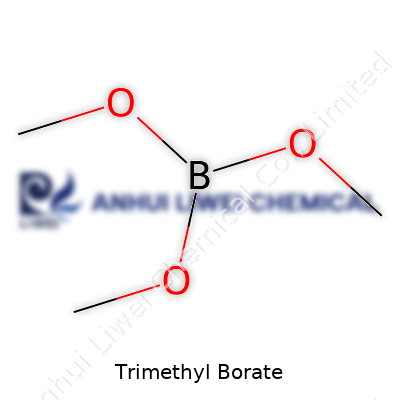
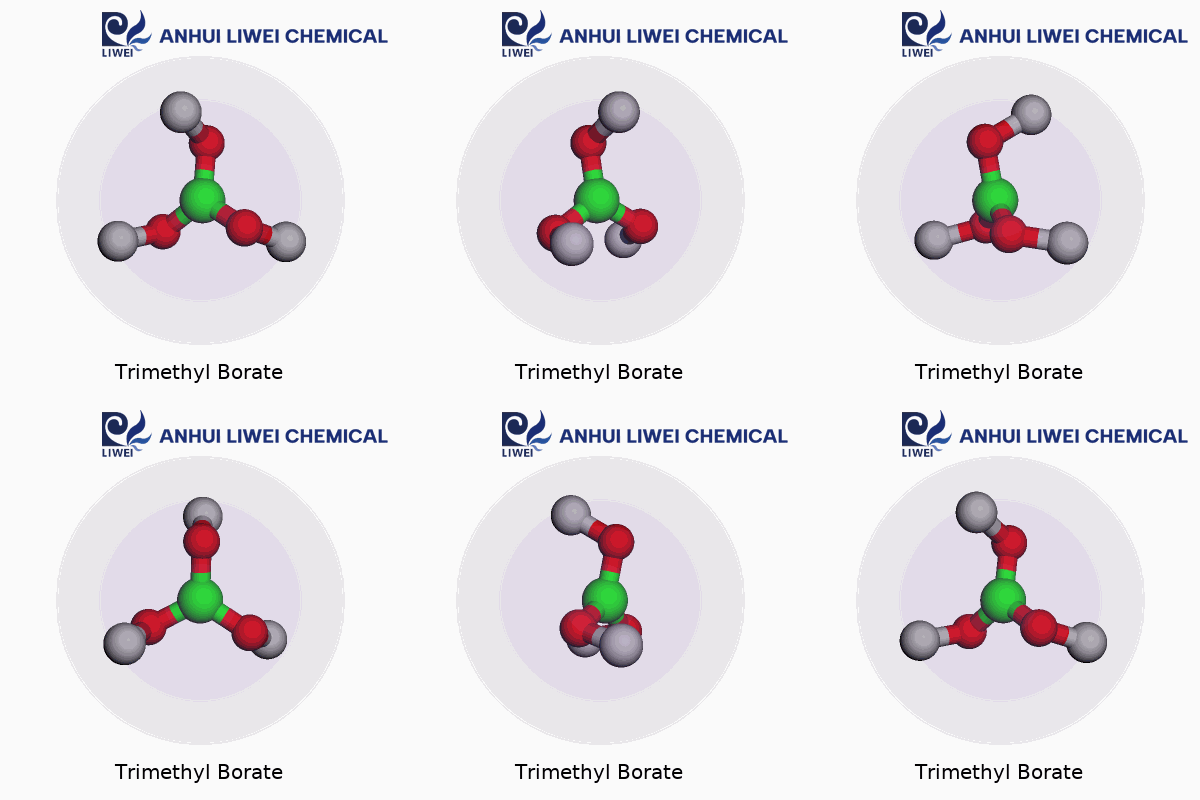
Trimethyl borate carries the chemical formula B(OCH3)3. In plain language, this means one boron atom sticks to three methoxy groups. Its structure is shaped like a tripod, where the boron sits in the middle and the three methyl groups spread out around it. Anyone who's handled this compound knows the faint, sweet aroma wafting from it. That scent doesn't show up in the textbooks but it's unmistakable in the lab.
Looking at the drawings, I see more than just lines and circles. Trimethyl borate presents a simple but effective model: take boron, a light element familiar to anyone who’s ever used borax in laundry, and combine it with methanol-derived arms. The oxygen in each methoxy group bonds to boron, forming a balanced, neutral molecule. This configuration translates to real-world behavior. Because boron pulls electron density toward itself, the molecule remains stable and easy to work with under dried conditions, but reacts quickly with water or alcohol.
In the glass industry, students and professionals learn early on that boron-based compounds help glass withstand thermal shock. Chemists walk into storerooms looking for trimethyl borate, not because it’s rare, but because it does one job very well: it serves as a boron source without introducing metal ions that mess with a reaction. That's not theory—that's years of practical chemistry.
Trimethyl borate evaporates quickly, making it a good candidate for specialized uses like producing boric acid or in organic synthesis as a methylating agent. The volatility comes with risk. Anyone who’s been near it knows leaving the cap off isn’t a small mistake, since vapors build up fast. Its flammable nature means safety goggles and proper ventilation matter as much as knowing the formula. These aren’t just lab rules; repeated accidents in academic labs show that even experienced folks must take care. NIOSH and OSHA already report cases of inhalation and fire hazards, which should make anyone respect what’s in their glassware.
Some chemicals fly under the environmental radar, but trimethyl borate lands right in the center. Because it breaks down quickly in water, turning into methanol and boric acid, runoff or improper disposal can change local water chemistry. Boric acid isn’t acutely toxic to humans, but it can hurt plants and aquatic life if concentrations get high. As a researcher, I’ve seen local waterways flagged for boron content. Responsible labs invest in collection and neutralization systems, so releases don’t end up shifting the ecological balance.
Personal health also ties into broader conversations. Methanol, a breakdown product, can cause harm if absorbed or inhaled in quantity. Wearing gloves and respecting fume hoods doesn’t just protect the user, it builds habits that ripple through a research culture. Sharing mistakes and near-misses helps keep everyone grounded.
Real change starts with hands-on learning. Storing trimethyl borate away from heat and moisture, keeping a fire extinguisher close, and using safer alternatives where possible make a difference. Substitution with less volatile boron sources offers a path, especially in educational settings.
Regular safety training, not just in textbooks but through real demonstrations and sharing stories, reinforces respect for compounds like trimethyl borate. Transparent incident reporting and support for disposal infrastructure protect both people and places. That’s not just good science—it’s building a smarter, safer future.
Trimethyl borate pops up mostly in labs and industries that handle organic synthesis. It’s clear this isn’t an everyday product. If you’ve ever worked with volatile chemicals, you know their moods can shift fast—one tiny slip can change a routine day into a safety nightmare. Trimethyl borate brings a flammability risk right to the front line. Its vapors spread easily and catch fire from sources many ignore, like a static spark or hot metal. Over the years, I’ve watched close calls when hoods or vents underperformed or folks forgot just how fast fumes travel.
No one who respects their health walks near trimethyl borate without goggles, gloves, and full coverage. Clean, dry hands mean better control. Chemical-resistant gloves, not those thin latex types, set the right tone. Goggles should wrap close to the skin. Splashes look innocent on a benchtop but behave far more dangerously on exposed tissue. Inhaling fumes causes throat and lung irritation that lingers for hours, sometimes days. Using a functioning fume hood cuts down on any direct breathing risk. Regularly checking the hood’s airflow saves a lot of pain later, something every safety officer pounds into new staff for good reason.
It only takes one bottle left out overnight to see why secure storage matters. Heat, sunlight, and air mix badly with trimethyl borate. Store it in tightly-sealed containers, well away from oxidizers or anything with an open flame. Keep these bottles low down, not overhead, in ventilated cabinets. I once saw a poorly stored bottle leak inside a closed cupboard—just a small puddle, but it cost half a day of work and an upended weekend to air out the building. A little care upfront beats an emergency call every time.
Sometimes the threat feels overblown until you realize how easy it is to let your guard down. Training new people to handle trimethyl borate means walking through each risk as if it’s the first day on the job. Spills have a way of happening fast, and knowing the right steps in the right order—contain, ventilate, clean using the right neutralizer—keeps folks safe and the workplace out of the headlines. Panic always makes a mess worse; maps showing spill kits and fire equipment need to be obvious and checked often.
Every experienced handler picks up patterns—double-checking caps, logging where every bottle sits, never skipping safety data training, and reviewing past mishaps to improve setups. These habits shape a culture where people look out for each other. Keeping drinks, food, and anything personal away from the work area strikes some as obvious, yet tired habits and rush jobs chip away at discipline. Every slip is a chance for real harm. Even one accident can hurt trust in the workplace and drag down everyone’s confidence.
Engineering controls like vented storage and automatic sensors for vapor build-up cut the risk more than posters or reminders by themselves. Good labeling, routine air monitoring, and easy access to emergency kits help deal with surprises before they escalate. As someone who has both taught and enforced safety steps, it’s clear that vigilance wins over wishful thinking. Keeping trimethyl borate from becoming tomorrow’s headline calls for patience, teamwork, and the refusal to skip steps—even on busy days.